Picture two fields that share a fenceline; they have the same soil type, the same crop and the same weather. A heavy storm passes through. On one field, water ponds, runs off, and erodes the soil into nearby waterways. The other field absorbs the rain and is able to utilize it in periods of heat and drought.
These differences in soil function can shape production, operating costs and recovery after stress. In this illustrative example, the first field may lose 25% of its yield with continued effects the following year, while the second field only loses 5% of its yield and is back to full productivity the following year.
Two Fields, TERRX’s research initiative, is developing ways to quantify dynamic soil function and its financial materiality. We are designing this to be incorporated into agricultural risk models across ag finance, including those used by lenders, insurers, reinsurers, farmland investors, and commodity buyers.
Soil type tells only part of the story.
Soil classifications are used extensively in ag finance and describe characteristics such as texture and drainage. This is what soil IS.
Management, however, can impact soil structure and affect water infiltration, holding capacity and availability. This is what soil DOES, and is largely absent from current financial risk analyses.
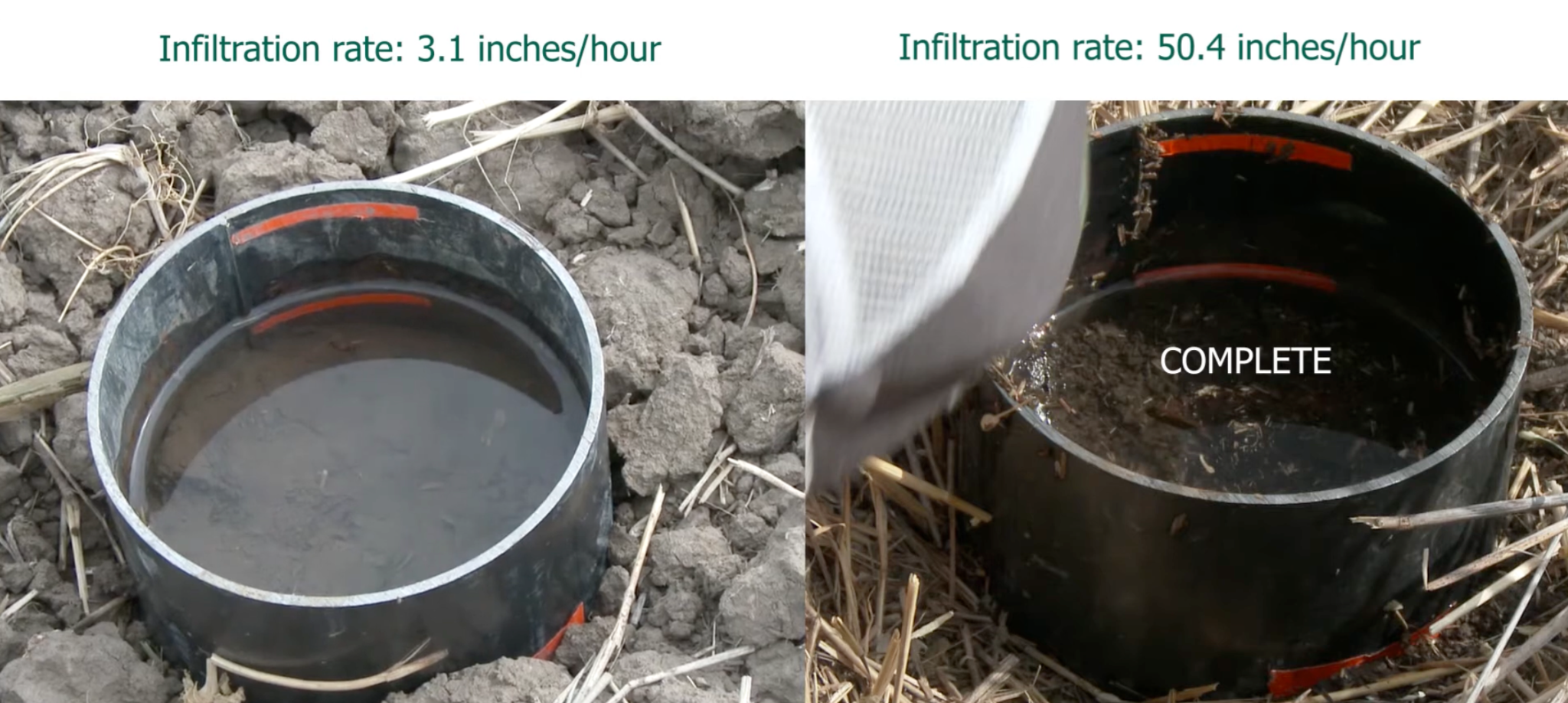
An infiltration test by the Montana NRCS compares the infiltration rates on the same soil type under two different management systems. The tests demonstrate dramatically different infiltration rates.
Source: Montana NRCS. Infiltration ring tests on Amsterdam silt loam soil. The management system on the left is tilled wheat followed by fallow. The management system on the right is no-till continuous wheat.
Our research challenge is to measure differences in soil function across fields and seasons, then test their consequences for agricultural production and financial risk.
Can we measure how soil functions under stress?
We are investigating whether satellite and aerial observations of crop stress and recovery can reveal differences in soil function. Comparing observed crop development with its expected growth curve could help identify how strongly a field responds to a weather event and how quickly it recovers. Water use, soil moisture and visible erosion provide additional candidate indicators.
Ground measurements are essential to interpreting those signals. We need to distinguish soil’s contribution from differences in crops, management and terrain, and test whether the indicators hold across seasons and growing regions. The aim is to measure physical performance directly enough that a practice label alone does not determine a field’s assessment.
When do those differences become financially material?
The financial research examines how production disruptions could affect income, costs and portfolio losses. How severe and widespread must yield losses be to materially affect a lender, farmland fund or commodity buyer? How does geographic concentration change the result?
We can model these sensitivities before a field-level soil indicator is fully validated. The two research tracks proceed alongside one another, with the eventual aim of testing whether measured differences in soil function help explain financially significant outcomes.
In partnership with the Soil Health Institute
Our research partnership with Soil Health Institute brings soil science and georeferenced field measurements into the development of remotely sensed indicators of soil function. Comparing observations from space with soil tests on the ground is central to establishing what those indicators measure and where they are reliable.
The collaboration connects Soil Health Institute’s soil science expertise with Two Fields’ remote-sensing and financial-materiality research. Peer-reviewed publication is part of the intended research program, providing a basis for others to examine the methods, findings and their limits.
Indicators for agricultural risk models.
The intended result is a set of tested indicators that agricultural risk models can use, with a clear account of their uncertainty and limits. These will help distinguish otherwise similar assets and evaluate whether improvements in soil function justify the cost of adaptation, given the time required and who receives the benefit.
Help build the evidence.
Research support will help develop the measurement methods, validate them across agricultural settings and test their financial materiality.
We welcome conversations with research funders, scientific collaborators and organizations that can contribute field observations or relevant financial data. For a lender, insurer, farmland fund or commodity buyer, collaboration could include examining how production disruptions affect its own portfolio and what evidence would improve its risk decisions.